
Reviewed · CU CHI TUNNELS TOURS
Cu Chi Luxury Group Tour – Tapioca and Cake Half Day
The most striking part of this tour is the chance to crawl through a section of the Cu Chi tunnel network, then see the hidden entrances, trapdoors, kitchens, command posts, and field hospitals built below the forest floor. The tunnels are partly adapted for visitors, but they still feel tight enough to make the underground war real.
I like the way the tour pairs the tunnels with ordinary rural scenes, including rice fields and overgrown bomb craters. I also like the simple cassava snack and hot tea, a small detail that connects the site with the food eaten during the war. Guides such as Long, Bao, Hien, and Tim have been especially good at explaining the events from more than one point of view.
The main drawback is uneven delivery. Some guides give detailed, engaging explanations, while others speak little English or rush the visit. Crowds, heat, a possible craft-factory stop, and missed tapioca or tea can also take the shine off an otherwise worthwhile outing.
In This Review
- Key points to know before booking
- What the Cu Chi Tunnels reveal underground
- The pickup from Ho Chi Minh City
- A possible craft stop on the road
- Watching the films before entering the site
- Finding the hidden entrances and trapdoors
- Crawling through a visitor-sized tunnel
- Rice fields, bomb craters, and the view above ground
- Cassava, wheat cake, and hot tea
- Shooting range and other optional costs
- Group size, guides, and the value of $21.99
- Who should book this Cu Chi outing
- Should you book it?
- FAQ
- How long does the Cu Chi Luxury Group Tour take?
- What is the tour price?
- Where does pickup take place?
- Where does the tour end?
- Is admission to the Cu Chi Tunnels included?
- Is food included?
- Is the shooting range included?
- How large is the group?
- Do I need to be physically fit?
- Can I cancel for a refund?
Key points to know before booking
- The tunnel crawl is the heart of the visit: Expect a tight passage adapted for visitors, plus tiny hiding entrances and trapdoors.
- The guide makes a major difference: Long, Bao, Hien, Tim, Bo, Thuy, and Jackie have been praised for clear and thoughtful presentations.
- This is not always a strict half-day: The tunnel visit is listed at about six hours, while the full outing is described as roughly seven hours with transport.
- The site can be hot and crowded: You may spend time standing outdoors while waiting for access to exhibits and tunnel sections.
- Cassava and tea are included: Wheat cake, bottled water, wet tissues, and entrance admission are also covered, though food service has occasionally been missed.
- A smaller group is worth asking about: The standard group can reach 25 people, while smaller bookings of nine or twelve have offered easier listening and more questions.
What the Cu Chi Tunnels reveal underground
The Cu Chi Tunnels are not just a short crawlway. They were built in three layers by Communist guerrilla fighters and developed into an underground system with living areas, weapons facilities, storage rooms, kitchens, ventilation, command centers, and field hospitals.
The network became a base during the struggle against the French in the 1940s and later during the American War, especially from 1961 to 1972. The point of the visit is to understand how people lived and fought below ground while military operations took place above them.
I find the scale hard to grasp from a museum display alone. Once you crouch near a concealed entrance or watch a guide demonstrate how a person disappeared under leaves and a trapdoor, the design becomes much easier to understand. The forest was not simply scenery. It helped hide movement, entrances, and supplies.
A 3D film introduces the largest American ground operation connected with the area. You also watch a documentary about the tunnel system and its military purpose. These presentations can feel dated, but they help establish the basic setting before you walk among the tunnels.
The site presents the Viet Cong viewpoint strongly, so listen carefully and keep the wider wartime setting in mind. The best guides, including Long, Hien, Bao, and Tim, have explained the tunnels in a way that recognizes the actions and suffering on more than one side. That balance matters at a place where traps, bombings, and underground survival are presented in close quarters.
More ways to visit the Cu Chi tunnels:
- Cu Chi Tunnels Tour from HCM City – Morning or Afternoon
★ 5.0 · 15,833 reviews - HCM: Cu Chi Tunnels-Tapioca Small Group Tour Morning or Afternoon
★ 5.0 · 7,485 reviews - Cu Chi Tunnels and Mekong Delta Signature Tour
★ 5.0 · 7,328 reviews
The pickup from Ho Chi Minh City
Pickup is offered from hotels in Districts 1, 3, and 4. If you are staying outside those areas, the listed meeting point is the Kim Travel office at 17 Thủ Khoa Huân in District 1, near Ben Thanh.
The transport is an air-conditioned minivan, and bottled water is included. The drive is a practical part of the outing rather than a scenic tour, but your guide may begin explaining the day and the wartime setting on the road to the site.
Allow plenty of time. The tunnel area is outside central Ho Chi Minh City, and the full outing can run close to seven hours. The listed tunnel visit itself is about six hours, so the difference likely reflects pickup, driving, and stops along the way.
One useful point from the experiences described is that some guides call ahead before pickup. That small check can prevent a missed meeting, especially when several central hotels have similar entrances. Drop-off is listed for District 1, and the activity ends back at the meeting point.
A possible craft stop on the road
Some versions of the day include a stop at a lacquer-art or handicraft workshop where people affected by Agent Orange make paintings and other pieces. This is not clearly listed among the core inclusions, but it appears in the actual day described by several participants.
I would treat this as an optional side stop rather than a reason to book. It can give you a look at a local social enterprise, and the visit has been described as interesting without pressure to buy. Still, it adds time to an already long, warm outing, and you may prefer to spend every available minute at the tunnels.
Ask your guide at the start whether the craft stop is planned. That lets you judge the pace and avoid wondering why the minivan has pulled in somewhere unrelated to the main site.
Watching the films before entering the site
The 3D movie and documentary provide a quick introduction to the tunnel system. You learn how the three levels worked, how ventilation was handled, and how the underground spaces served different purposes.
Do not expect a polished museum presentation. The value is in getting the basic layout before you see the entrances and reconstructed sections in person. If your guide adds clear explanations, the film becomes a useful starting point. If the guide gives little commentary, the presentation may feel more like a required stop than a full lesson.
This is one reason the guide matters so much. A well-prepared guide can connect the film to the actual rooms, crater sites, and forest paths. Guides such as Bo and Hien have been praised for answering questions and adding context instead of simply moving the group from one display to the next.
A few more Ho Chi Minh City half-days to weigh up
- Mekong Delta 4 Islands, TukTuk, Boat, Try Khot Cake Local Cooking
★ 5.0 · 1,148 reviews - HCM: Authentic Mekong Delta – Boat, TukTuk, Khot Cake Making
★ 4.7 · 380 reviews - Full Day Experience to Farm and Chocolate
★ 5.0 · 22 reviews - Bean to bar Chocolate Workshop in Ho Chi Minh City
★ 5.0 · 10 reviews
Finding the hidden entrances and trapdoors
One of the most memorable demonstrations is the tiny hiding entrance. A local fighter could lower into the ground and cover the opening with leaves, making it difficult to spot from above.
You may also get a chance to try entering one yourself. This is a hands-on moment, but it is not a stunt for everyone. You need to bend, crouch, and move carefully. The tour information calls for a strong level of physical fitness, and that warning is sensible.
The displays also show trapdoors and other defensive features. These can be uncomfortable to look at, particularly when you consider that they were designed for combat rather than display. A good guide should explain their purpose without turning the site into a theatrical war show.
The surrounding forest gives you a better sense of concealment than a city museum could. Paths lead past vegetation, openings, and earthworks connected to the tunnel system. You might also see rice fields worked by villagers in areas where tunnels run below the ground.
Crawling through a visitor-sized tunnel
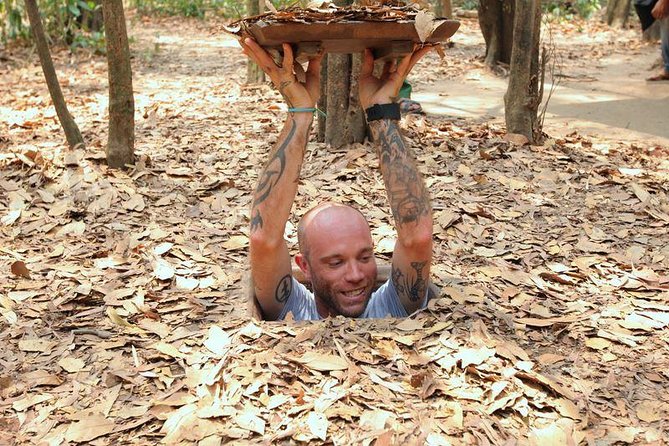
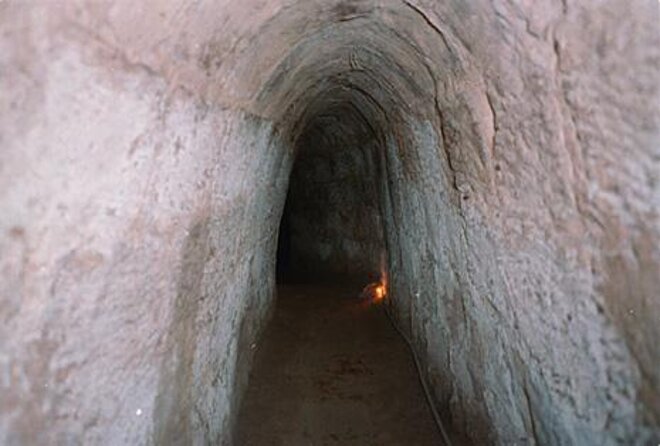
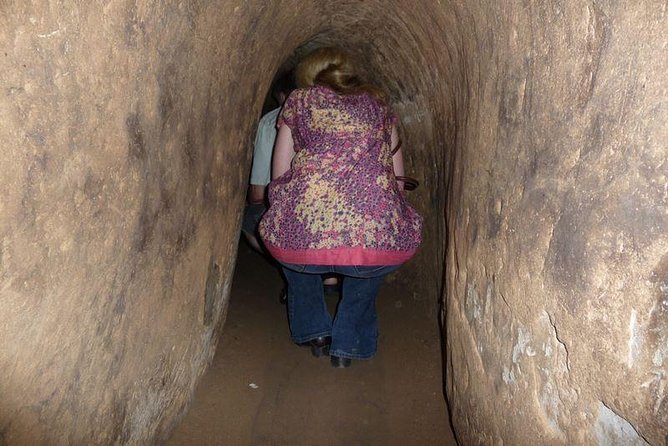
The tunnel crawl is the part most people remember. The section open to the public has been widened compared with the original passages, yet it remains low and narrow enough to give you a physical sense of underground life.
You may walk or crouch through the passage for a short distance, depending on the section open during your visit. Do not expect a comfortable underground stroll. Heat, low ceilings, and limited room can make even a brief passage tiring.
If you dislike confined spaces, you can still learn a great deal from the entrances and surface exhibits without forcing yourself through the tunnel. If you do enter, move at your own pace and follow the guide’s instructions. The physical experience is valuable because it turns measurements and descriptions into something your body understands.
The crawl also makes the original conditions easier to picture. Fighters lived, worked, treated injuries, stored supplies, prepared food, and directed operations in spaces that were far smaller than most modern rooms. The visit is most effective when you pause to think about that daily routine rather than treating the tunnel as a quick photo stop.
Rice fields, bomb craters, and the view above ground
The visit is not entirely underground. Nearby rice fields show that ordinary rural life continues around the historic site. Some fields sit above parts of the tunnel network, a reminder that the military system was woven into the local countryside.
Overgrown blast craters mark the damage caused by aerial bombing campaigns. Vegetation has returned, but the depressions in the ground remain visible. They are quiet features, and you could easily pass them without a guide pointing them out.
I value these outdoor details because they add scale. The tunnel rooms tell you how people survived below ground. The fields and craters show the world above them, where farming, bombardment, and military movement occupied the same patch of earth.
Expect sun and heat while walking between stops. Crowds can gather around the exhibits and tunnel entrances, causing periods of standing outside. A small group makes it easier to hear the guide and ask questions, but it will not remove the site’s basic crowding at busy times.
Cassava, wheat cake, and hot tea
Cassava, also called tapioca in the tour description, was a common food during wartime life at Cu Chi. You receive cassava with Vietnamese hot tea, along with wheat cake, bottled water, and wet tissues.
The snack is modest, and that is the point. It is not a full meal. Think of it as a short cultural detail that links the visit to the food described at the site. The hot tea is welcome after walking in the forest, though it may not feel refreshing on a very hot day.
Food service has not been perfectly consistent. Some people have left without receiving the tapioca and tea that were supposed to be included. If this matters to you, confirm the snack with your guide before leaving the site rather than assuming it will appear at the end.
Shooting range and other optional costs
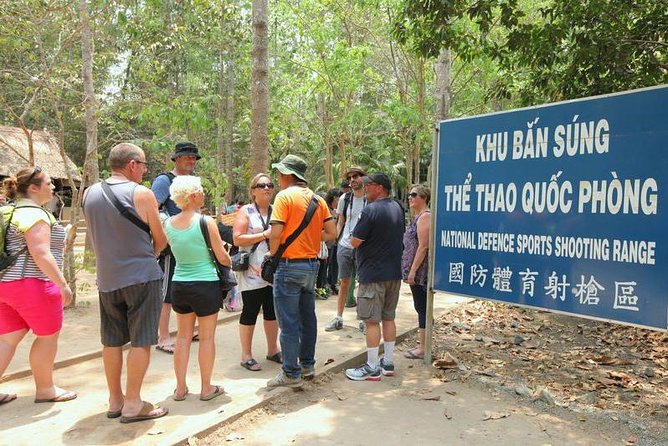
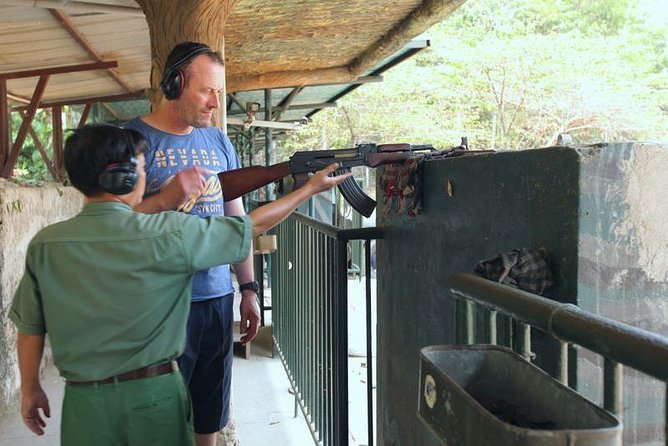
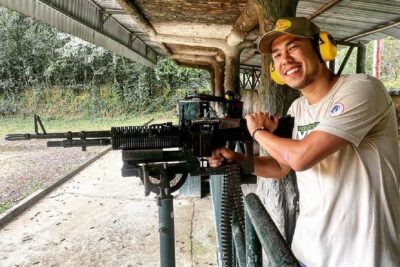
A shooting range may be available, with rifles such as an M16 mentioned in the experience descriptions. This costs extra and is not part of the tour price.
The range changes the mood of the visit. Gunfire can make the setting feel more immediate, but it can also be loud and unsettling, especially when you are trying to listen to a historical explanation. You do not need to use it to understand the tunnels.
Ask about the price before taking part. The core cost covers the tunnel admission and listed refreshments, not every activity offered at the site.
Group size, guides, and the value of $21.99
At $21.99 per person, this is an inexpensive way to reach the Cu Chi Tunnels from Ho Chi Minh City. The price includes pickup from selected central districts, air-conditioned transport, an English-speaking guide, entrance admission, insurance, bottled water, cassava, tea, wheat cake, and wet tissues.
That package offers good value if you want transport and interpretation handled together. A private taxi to the site would not include the guide’s explanations or admission, while arranging the visit independently would require more planning.
The trade-off is a group that can reach 25 people. At that size, you may stand farther from the guide, wait longer at tunnel entrances, and have fewer chances to ask questions. Smaller groups of nine or twelve have provided a more comfortable format, and one family upgraded to a private tour for more control and less waiting.
If you care about the historical explanation, ask about the smallest available group before paying. The extra cost, if offered, may be worthwhile for people who want to hear every detail. The standard price is still fair for a budget half-day outing, but do not expect the intimacy of a private guide.
Guide quality has varied sharply. Kim, Hien, Long, Bao, Thuy, Bo, Simon, Lam, Tim, Kelvin, Lee, Xam, Phee, Jackie, and Niem have all been named as effective guides in different outings, with praise for clear English, humor, personal insight, and careful attention. At the same time, at least one outing suffered from very limited English and little historical explanation, and another was described as rushed with an impolite guide and unsafe driving.
That range is worth keeping in mind. The company has a very high overall rating, but your guide remains the biggest variable in the day.
Who should book this Cu Chi outing
I would recommend it to you if you want a direct, physical introduction to the Vietnam War and prefer having transport, admission, and an English-speaking guide arranged in one booking.
It suits people interested in military history, engineering, rural life, and the human cost of war. It also works well for families with older children who can manage the heat and crawlway, though the physical-fitness warning should be taken seriously.
You may want another format if you dislike narrow spaces, cannot crouch or crawl, or want a quiet private visit. You should also consider a smaller group if asking questions is important to you.
Book with enough flexibility for the day to run long. Free cancellation is available up to 24 hours before the start time, but changes or cancellations inside that window are not accepted. The tour also requires a minimum number of participants, so a cancellation by the operator may result in another date, another experience, or a full refund.
Should you book it?
Yes, if you want a low-cost, well-organized introduction to the Cu Chi Tunnels and can accept crowds, heat, and some uncertainty over the guide. The tunnel crawl, concealed entrances, rural fields, bomb craters, and wartime cassava make this more meaningful than a simple transport-and-photo stop.
For the best version, request a small group, confirm the pickup, ask if the craft stop is planned, and check that cassava and tea will be served. If the guide is Long, Bao, Hien, Tim, Bo, Thuy, or another guide who gives the site time and context, the day can be excellent. If you need guaranteed depth and a slower pace, pay for a private option if available.
FAQ
How long does the Cu Chi Luxury Group Tour take?
The experience is described as approximately seven hours, while the tunnel visit itself is listed at six hours. Pickup, driving, and possible stops are part of the full day.
What is the tour price?
The listed price is $21.99 per person. Group discounts may be available.
Where does pickup take place?
Pickup is offered from hotels in Districts 1, 3, and 4. The listed meeting point is the Kim Travel office at 17 Thủ Khoa Huân in District 1.
Where does the tour end?
The activity ends back at the meeting point, with drop-off listed in District 1.
Is admission to the Cu Chi Tunnels included?
Yes. The entrance fee is included in the tour price.
Is food included?
Yes. Cassava, Vietnamese hot tea, wheat cake, bottled water, and wet tissues are included. Food service has occasionally been missed, so confirm the refreshments with your guide.
Is the shooting range included?
No. Shooting-range activities, including the M16 option mentioned in the tour details, cost extra.
How large is the group?
The group can include a maximum of 25 people. Smaller group and private options have also been booked, including groups of nine and twelve.
Do I need to be physically fit?
Yes. The tour information recommends a strong level of physical fitness. The experience includes walking, crouching, and crawling through a narrow tunnel section.
Can I cancel for a refund?
You can cancel up to 24 hours before the start time for a full refund. Cancellations or changes made less than 24 hours before the start time are not accepted, and the tour may be canceled if its minimum number of participants is not reached.
Just added around Ho Chi Minh City
- Vung Tau City Shore Excursion from Phu My Port★ 5.0 · 3 reviews
- Ho Chi Minh city Street Food by scooter tour | female driver★ 5.0 · 3 reviews
- Ho Chi Minh City: Full Long Tan Battlefield Tour★ 4.7 · 3 reviews
- Ride Saigon: Private Half-Day Motorbike Adventure★ 5.0 · 3 reviews
- Ho Chi Minh City: Guided Food Tour by Scooter★ 5.0 · 3 reviews
- PHU MY SHORE EXCURSION: Saigon Past and Present Tour★ 5.0 · 3 reviews
- Ho Chi Minh: Cai Be-Mekong Delta Local Village Full Day Tour★ 3.7 · 3 reviews
- 3D2N Mekong Delta Tour: Cycling – Kayaking – Floating Market★ 5.0 · 3 reviews
Cu Chi Tunnels Tours, compared.
Cu Chi Tunnels Tour from HCM City – Morning or Afternoon
Read our review →
Cu Chi Tunnels-Tapioca Small Group Tour Morning or Afternoon
Read our review →
Cu Chi Tunnels and Mekong Delta Signature Tour
Read our review →
Cu Chi Tunnels and Mekong Delta Full Day Tour – Max 12
Read our review →
Full-Day Cu Chi Tunnels and Mekong Delta Tour
Read our review →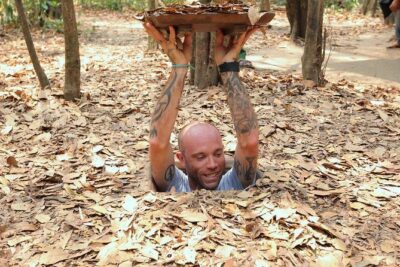
CuChi Tunnels&Mekong Delta-Boat,TukTuk,Coconut Village SmallGroup
Read our review →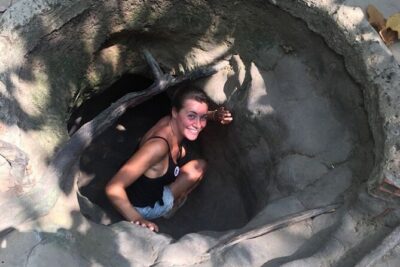
Adventure Cu Chi Tunnels and Mekong Delta Tour From HCM
Read our review →Browse the lists this tour appears in