
Reviewed · DESSERT TOURS
Bean to bar Chocolate Workshop in Ho Chi Minh City
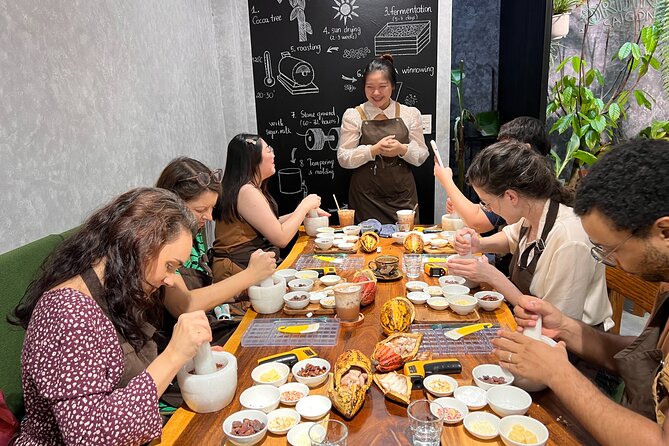
The most interesting part of this Ho Chi Minh City workshop is that you start with the fresh cacao pod, not a packet of melted chocolate. You taste the fruit, husk beans, grind cacao paste with a granite stone mortar, and then make and decorate your own bars at Ban Cacao, a Vietnamese chocolate maker.
I like the clear connection to local ingredients and the fact that you leave with chocolate you made yourself. I also like the small group limit of 10 people, which should make a practical activity easier to follow. The one caution is the hand grinding. It is tiring, especially for children, so this is not a sit-back-and-snack class.
In This Review
- Key points
- From Cacao Pod to Chocolate Bar in Two Hours
- Starting with the Fresh Cacao Pod
- Husking Beans by Hand
- Grinding Cacao Paste with a Granite Mortar
- Mixing, Measuring, and Shaping Your Chocolate
- Decorating Wrappers and Taking Chocolate Home
- A Chocolate Drink Included with the Class
- What the $32 Price Really Buys
- Who Will Enjoy This Workshop Most
- Practical Details Before You Book
- Should You Book Ban Cacao?
- FAQ
- How long does the Bean to Bar Chocolate Workshop last?
- Where does the workshop begin?
- Where does the activity end?
- What is included in the chocolate-making process?
- What ingredients are provided?
- What tools are used in the class?
- Can I take chocolate home?
- Is the workshop suitable for children?
- How many people can join the workshop?
Key points
- Fresh cacao tasting: Try cacao fruit before it becomes beans, paste, or chocolate.
- Traditional grinding: Use a granite mortar to make cacao paste by hand.
- Vietnamese context: Learn how local cacao and ingredients become chocolate bars.
- Hands-on from start to finish: Work with beans, nibs, cacao butter, and cane sugar.
- A useful take-home souvenir: Decorate your own wrappers and take home your chocolate bars.
- Short, central format: The class lasts about two hours at 89/14 Hàm Nghi in District 1.
From Cacao Pod to Chocolate Bar in Two Hours
This is a compact food workshop built around the full chocolate-making process. You do not simply watch a demonstration or pour prepared chocolate into a mold. The class introduces you to the stages that connect a cacao fruit to the finished bar in your hand.
The session covers the history of cacao in Vietnam and explains how Vietnamese chocolate makers use local cacao and other ingredients. That background matters because it gives the activity a sense of place. You are not making a generic candy bar in a kitchen anywhere in the world. You are learning how chocolate is made from cacao grown and used in Vietnam.
The class takes place at Ban Cacao, a Vietnamese chocolate maker, at 89/14 Hàm Nghi in District 1. It ends at the same location. The meeting point is near public transportation, and the mobile ticket makes it easy to keep your booking on your phone while you explore central Ho Chi Minh City.
Two hours is a good length for this type of activity. You get enough time to handle the ingredients and complete the main stages, but the session does not take half a day away from museums, markets, or city sightseeing.
A few more Ho Chi Minh City half-days to weigh up
- Cu Chi Luxury Group Tour – Tapioca and Cake Half Day
★ 5.0 · 3,375 reviews - Mekong Delta 4 Islands, TukTuk, Boat, Try Khot Cake Local Cooking
★ 5.0 · 1,148 reviews - HCM: Authentic Mekong Delta – Boat, TukTuk, Khot Cake Making
★ 4.7 · 380 reviews
Starting with the Fresh Cacao Pod
The workshop begins at the most basic point in the process: the cacao fruit. You get to taste fresh cacao pods and see the material that eventually produces cacao beans.
This is a useful step because many people know chocolate only as a finished product. The fresh fruit helps you understand that cacao is not naturally a chocolate bar. It must be opened, processed, dried, husked, ground, mixed, shaped, and finished.
Tasting the fresh cacao also gives the class a food component beyond sweetness. You can compare the fruit with the later stages of the process and see how much work is required before chocolate develops its familiar taste.
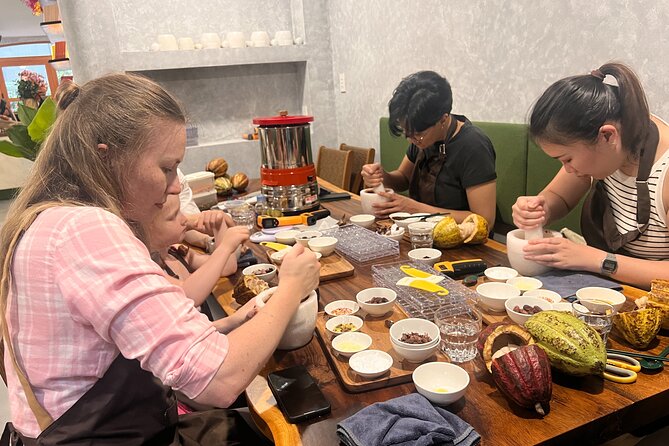
The supplied materials include fresh cacao fruits, cacao beans, cacao nibs, cacao butter, and cane sugar. Each item plays a different role. The beans and nibs show the solid cacao material, cacao butter contributes fat and texture, and cane sugar balances the bitter cacao flavor.
Do not expect a large tasting menu. This is a focused introduction to cacao, with the fresh pod serving as the unusual starting point.
Husking Beans by Hand
After the fresh cacao introduction, you husk your own cacao beans. This is a simple but important task because it shows how the beans change as you move closer to usable cacao.
Husking can look easy when someone else does it quickly. Doing it yourself slows you down and makes the process more memorable. You can see the difference between the outer husk and the cacao inside, rather than treating beans as a ready-made ingredient.
This part also suits curious children and first-time chocolate makers because it is direct and easy to understand. There is no need for advanced cooking experience. You follow the process step by step and handle the raw material yourself.
The class is recommended for children over eight based on the physical effort involved later in the session. An eight-year-old did take part successfully, but the grinding section was tiring. If you are booking for a family, that is the main point to keep in mind.
Grinding Cacao Paste with a Granite Mortar
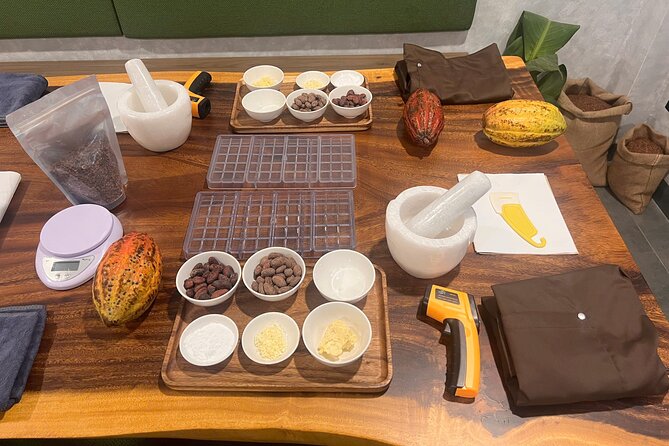
The most physical part of the experience is making cacao paste in the traditional style with a granite stone mortar. The workshop provides a granite mortar, along with a scale and thermometer for the later stages.
Hand grinding gives you a better feel for the work behind chocolate than a quick machine demonstration would. You must spend time breaking down the cacao material and turning it into paste. The method is slower, but that is part of the lesson.
I like this stage because it connects the finished bar with an old-fashioned method rather than hiding the hard work behind equipment. It also gives the class a practical edge. You are not just hearing how chocolate is made. You are doing one of the central jobs yourself.
The drawback is clear: your arms may get tired. For adults, that is likely part of the fun. For younger children, it may be the point where they need help or a break. Parents should treat this as a shared activity rather than assume a child will handle every step alone.
A completely different kind of day out of Ho Chi Minh City:
- Cu Chi Tunnels Tour from HCM City – Morning or Afternoon
★ 5.0 · 15,833 reviews - From HCM City: Mekong Delta Tour with Sampan Journey
★ 4.5 · 13,132 reviews - Ho Chi Minh City Street Food Tour & Sightseeing By Motorbike
★ 5.0 · 9,413 reviews - HCM: Cu Chi Tunnels-Tapioca Small Group Tour Morning or Afternoon
★ 5.0 · 7,485 reviews
Mixing, Measuring, and Shaping Your Chocolate
Once you have worked through the cacao paste, the class moves toward making the chocolate bar. The ingredients include cacao butter and cane sugar, and the equipment includes a thermometer and scale.
Those tools are not decorative. Temperature and proportions affect chocolate texture, so using them gives you a basic lesson in chocolate-making technique. The scale shows why careful quantities matter, while the thermometer introduces the need to control heat during preparation.
You then use a chocolate mold to shape the chocolate. This is the point when the loose ingredients begin to look like a finished product. The mold also makes the activity approachable. Even if your mixture is not perfectly smooth or professionally finished, it becomes something you can take away.
The workshop is designed to take you from the first step to the final bar. That full sequence is its main strength. Many short food activities focus on one attractive moment, such as decorating or tasting. Here, the decoration comes after you have seen and handled several earlier stages.
Decorating Wrappers and Taking Chocolate Home
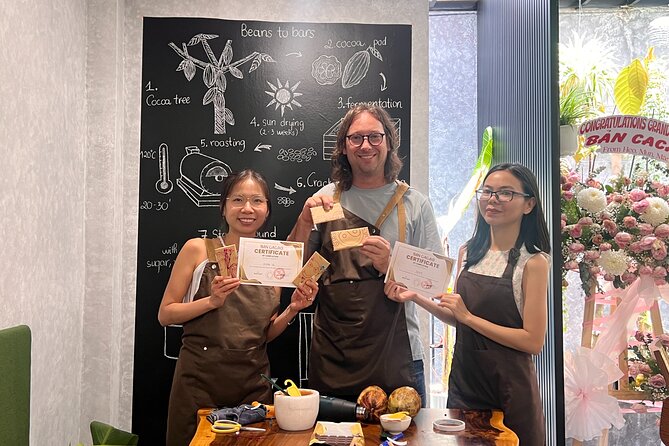
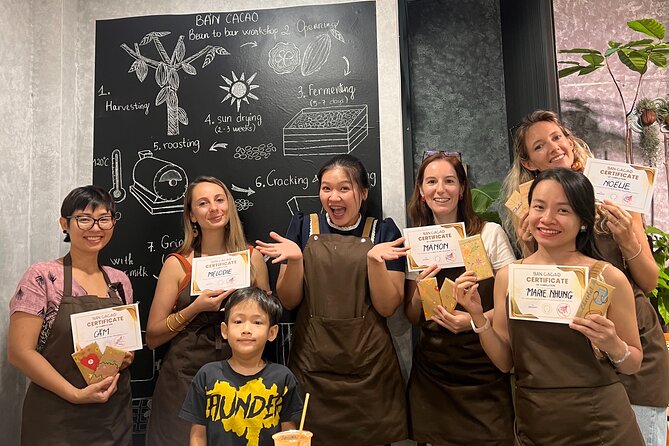
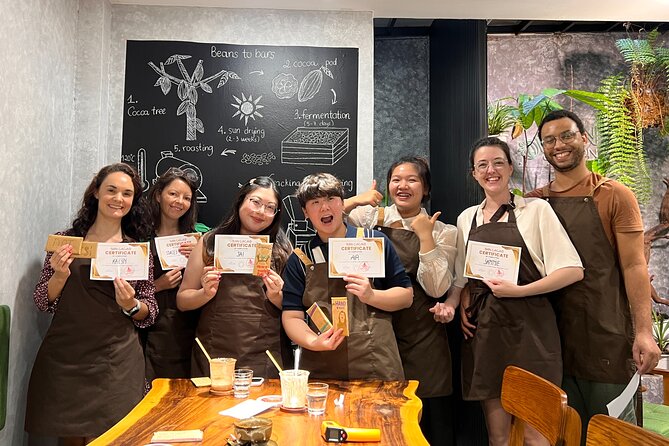
The final creative step is decorating your chocolate and its wrapping paper. This gives you a personal souvenir rather than a standard product bought from a shop.
The wrapper matters because it preserves the memory of the class in a simple way. You can identify your own bars later, and children get a craft activity after the more physical grinding work.
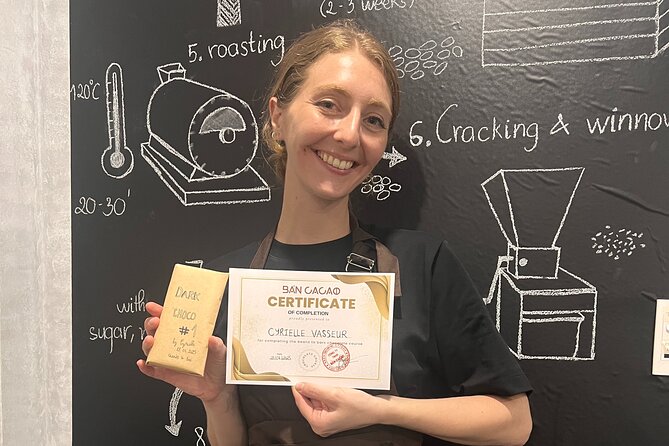
The experience includes chocolate to take home. A family booking produced two bars per person, along with personally decorated wrappers, so you should expect a useful edible souvenir rather than one tiny sample.
The bars may not look factory-perfect. That is the point. Your finished chocolate records the work you did in the class. It is a better reminder of the activity than a professionally packaged bar from a shelf, even if the shape or decoration is a little uneven.
A Chocolate Drink Included with the Class
The class also includes a drink for each participant. The available account of the experience specifies a hot or iced chocolate, and both options were described as enjoyable.
This is a welcome extra during a hands-on session. It gives you another way to taste chocolate while you work through the ingredients and process. The drink is not the main reason to book, but it adds value to the $32 price.
For families, the drink can also provide a pleasant pause during the workshop. Children may appreciate it while adults handle some of the more tiring grinding. The exact serving style can depend on the class, so choose hot or iced if that option is offered when you arrive.
What the $32 Price Really Buys
At $32 per person, this is more than a chocolate tasting and less than a full-day culinary course. The price covers about two hours of instruction and access to the ingredients and tools needed for the activity.
You are working with fresh cacao fruit, beans, nibs, cacao butter, cane sugar, a granite mortar, a thermometer, a scale, molds, and wrapping paper. You also receive a drink and take-home chocolate. That makes the cost easier to justify than an activity where you only sample finished products.
The value is strongest if you want an experience rather than a box of chocolate. You could buy a bar for less, but you would not get the process, the local context, or the chance to make and decorate your own.
The price may feel high if you are looking only for a quick snack or a professional chocolate tasting. It is also not aimed at people who dislike practical work. You are paying for participation, instruction, ingredients, and a small souvenir.
The maximum group size is 10. That is a useful limit for a workshop involving shared explanations, tools, and individual chocolate molds. A small group should also make it easier to follow the stages without waiting through a large crowd.
Who Will Enjoy This Workshop Most
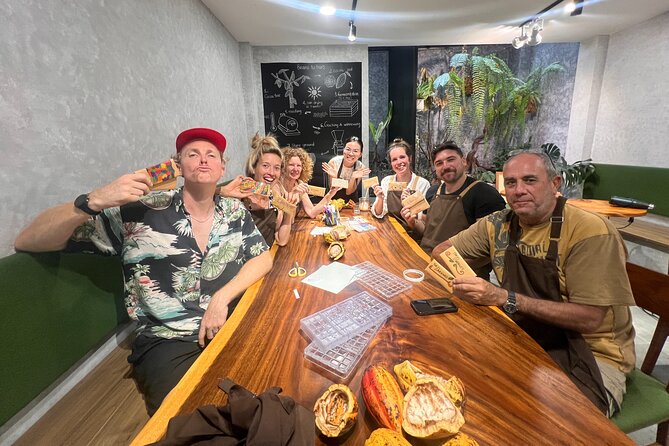
I would recommend this class to food-minded visitors who want an activity with local character. It works especially well for couples, families with older children, and anyone who likes learning by handling ingredients.
Families should note the age-related practical issue. The class suits children over eight, but the grinding section can be tiring. Parents should be ready to help rather than expect every child to complete the mortar work without assistance.
It is also a good choice for a short stay in Ho Chi Minh City. The two-hour schedule leaves most of the day free, and the District 1 address makes it easy to fit around other central activities.
Chocolate fans will get the most from the process if they are curious about how cacao becomes chocolate. If you only want to eat sweets, a shop visit may be simpler. This class asks you to spend time on the less glamorous steps before you get the reward.
Practical Details Before You Book
The meeting point is 89/14 Hàm Nghi, Phường Nguyễn Thái Bình, Quận 1, Ho Chi Minh City. The activity ends back there, so you do not need to arrange a separate return transfer.
The workshop is near public transportation. Since the supplied information does not specify a particular station or route, check your map on the day and allow enough time to reach the address.
Bookings are confirmed at the time of booking, and a mobile ticket is accepted. The activity is often booked about 11 days ahead, so reserve early if your schedule is fixed, especially if you want a particular date.
Free cancellation is available if you cancel at least 24 hours before the local start time. Cancellations or changes made less than 24 hours ahead are not accepted for a refund.
Should You Book Ban Cacao?
Book this workshop if you want to understand chocolate as a process, not just a dessert. The fresh cacao tasting, hand husking, granite-mortar grinding, bar making, decorating, and take-home chocolate give you a clear two-hour story from fruit to finished product.
I especially like it for families with children over eight and for visitors looking for something different from standard city sightseeing. Keep the hand grinding in mind, and do not expect a passive tasting. At $32, the value is in the hands-on work, local cacao context, drink, and chocolate bars you make yourself.
FAQ
How long does the Bean to Bar Chocolate Workshop last?
The class lasts approximately two hours.
Where does the workshop begin?
It begins at Ban Cacao at 89/14 Hàm Nghi, Phường Nguyễn Thái Bình, Quận 1, Ho Chi Minh City, Vietnam.
Where does the activity end?
The activity ends back at the meeting point.
What is included in the chocolate-making process?
You learn about the process from cacao pods to chocolate bars, taste fresh cacao pods, husk cacao beans, make cacao paste with a granite mortar, and create and decorate chocolate bars.
What ingredients are provided?
The materials include fresh cacao fruits, cacao beans, cacao nibs, cacao butter, and cane sugar.
What tools are used in the class?
The workshop uses a granite mortar, thermometer, scale, chocolate mold, and wrapping paper.
Can I take chocolate home?
Yes. You make chocolate bars, decorate the wrapping, and take your finished chocolate home. A family class produced two bars per person.
Is the workshop suitable for children?
The class is recommended for children over eight. The grinding section can be tiring, so younger participants may need help.
How many people can join the workshop?
The maximum group size is 10 participants.
More Workshops in Ho Chi Minh City
- Cai Be Mekong Delta Tour: Cooking Class, Cycling & Craft Villages
★ 5.0 · 1,881 reviews - Chef Vu Cooking Class Plus Market Trip in Saigon Center (Pick up by Cyclo)
★ 5.0 · 477 reviews - Immersive Cooking Class & Market Tour By Local Chef+Cookbook
★ 4.8 · 426 reviews - Immersive Cooking Class & Wet Market Tour by Local Chef +Cookbook
★ 5.0 · 367 reviews
Just added around Ho Chi Minh City
- Ho Chi Minh city Street Food by scooter tour | female driver★ 5.0 · 3 reviews
- Vung Tau City Shore Excursion from Phu My Port★ 5.0 · 3 reviews
- Ho Chi Minh City: Full Long Tan Battlefield Tour★ 4.7 · 3 reviews
- Ride Saigon: Private Half-Day Motorbike Adventure★ 5.0 · 3 reviews
- Ho Chi Minh City: Guided Food Tour by Scooter★ 5.0 · 3 reviews
- PHU MY SHORE EXCURSION: Saigon Past and Present Tour★ 5.0 · 3 reviews
- Ho Chi Minh: Cai Be-Mekong Delta Local Village Full Day Tour★ 3.7 · 3 reviews
- 3D2N Mekong Delta Tour: Cycling – Kayaking – Floating Market★ 5.0 · 3 reviews
Dessert Tours, compared.

Cu Chi Luxury Group Tour – Tapioca and Cake Half Day
Read our review →
Mekong Delta 4 Islands, TukTuk, Boat, Try Khot Cake Local Cooking
Read our review →
Authentic Mekong Delta – Boat, TukTuk, Khot Cake Making
Read our review →
Browse the lists this tour appears in