
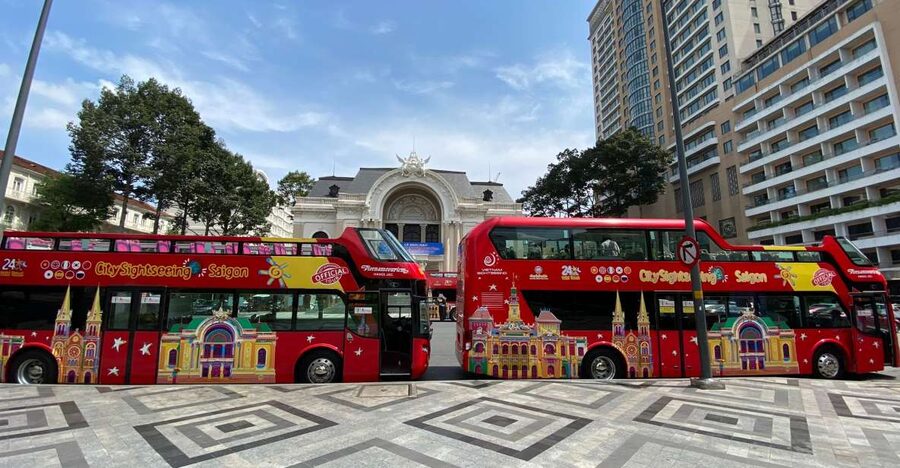
Reviewed · CITY TOURS
Saigon: City Sightseeing Hop-On Hop-Off Bus Tour
Saigon is easiest to understand from above, and this bus gives you a useful first look at its French colonial buildings, crowded streets, markets, museums, and pagodas. I especially like the two daytime routes and the choice to sit upstairs for views or downstairs in air-conditioning. The free Wi-Fi and multilingual audio are handy extras.
I also like that you can make the ride as active or as lazy as you wish. Complete one loop to get your bearings, then hop off at Ben Thanh Market, the War Remnants Museum, or a temple. The main drawback is timing: buses run every 30 minutes on the red route and every 45 minutes on the blue route, and some stops are not clearly marked.
In This Review
- Key points
- Why a bus is useful in Ho Chi Minh City
- Starting beside the Saigon Opera House
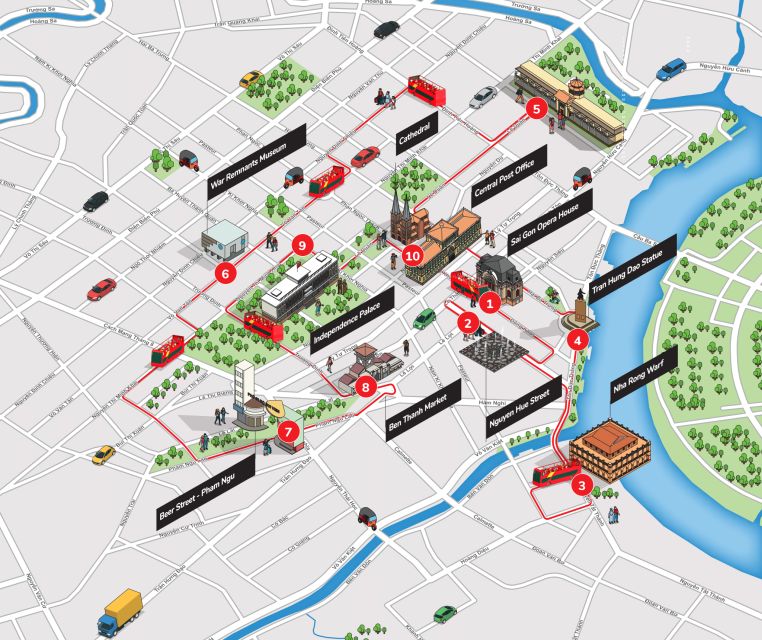
- Red Route: central Saigon in 75 minutes
- Saigon Opera House and Nguyen Hue Street
- Nha Rong Wharf
- Tran Hung Dao Statue
- Museum of Vietnamese History
- War Remnants Museum
- Pham Ngu Lao Street
- Ben Thanh Market
- Independence Palace
- Notre Dame Cathedral and Central Post Office
- Blue Route: District 5, markets, and temples
- Beer Street and Ben Thanh Market
- Ho Thi Ky Flower Market
- Phuoc An society’s premises
- Ong Bon Pagoda
- Binh Tay Market
- Thien Hau Pagoda
- Van Phat Pagoda
- Top deck views, air-conditioning, and weather
- Is $21 good value?
- Recorded audio and the role of staff
- Practical ways to plan your day
- Who should book this bus?
- FAQ
- How long is each bus route?
- How often do the buses run?
- What time do the daytime routes operate?
- Where do I exchange my ticket?
- Which languages are available for the audio guide?
- Are attraction tickets or food included?
Key points
- Two routes, four districts: The red route covers central sights, while the blue route reaches District 5 and several important temples and markets.
- Best first ride: Complete a full loop before getting off, so you can see how the city fits together.
- Open-top views: The upper deck gives you a good view of colonial buildings, traffic, and city life, while the lower deck offers air-conditioning.
- Recorded commentary: Audio is available in nine languages, though traffic noise and occasional poor timing can affect it.
- Useful practical extras: Free Wi-Fi, headphones, a guidebook, maps, recommendations, timetables, and coupons are included.
- Good for short stays: A one-day pass costs $21 per person, while a two-day pass makes more sense if you plan to visit several stops.
Why a bus is useful in Ho Chi Minh City
Ho Chi Minh City can feel like several cities stitched together. The grand buildings around the Opera House and Nguyen Hue Street give way to riverfront warehouses, backpacker streets, food stalls, markets, and temple districts. Walking between all of these areas takes time, and the heat and traffic can make a simple sightseeing day feel like hard work.
This bus gives you a high seat and a little breathing room. From the upper deck, you can watch the stream of motorbikes, passing shopfronts, colonial facades, and daily street life. It is not a substitute for walking, but it is a smart way to decide where you want to spend your limited time.
I would use the tour in two stages. First, ride a complete loop without getting off. Listen to the commentary and note the stops that catch your eye. Then use the remaining time to return to one or two places that deserve a closer look.
The recorded guide is available in English, Spanish, German, French, Chinese, Japanese, Korean, Vietnamese, and Russian. It provides useful background on the buildings and districts, although it cannot answer questions or adjust its pace like a live guide. The sound can also be hard to hear above Saigon traffic, and the audio does not always line up perfectly with the building you are passing.
A few more Ho Chi Minh City half-days to weigh up
- Ho Chi Minh City Street Food Tour & Sightseeing By Motorbike
★ 5.0 · 9,413 reviews - Saigon: Street Food Tasting & Sightseeing Tour by Motorbike
★ 4.9 · 3,578 reviews - Saigon: City Sightseeing 45-Minute Panoramic Night Tour
★ 4.3 · 964 reviews
Starting beside the Saigon Opera House

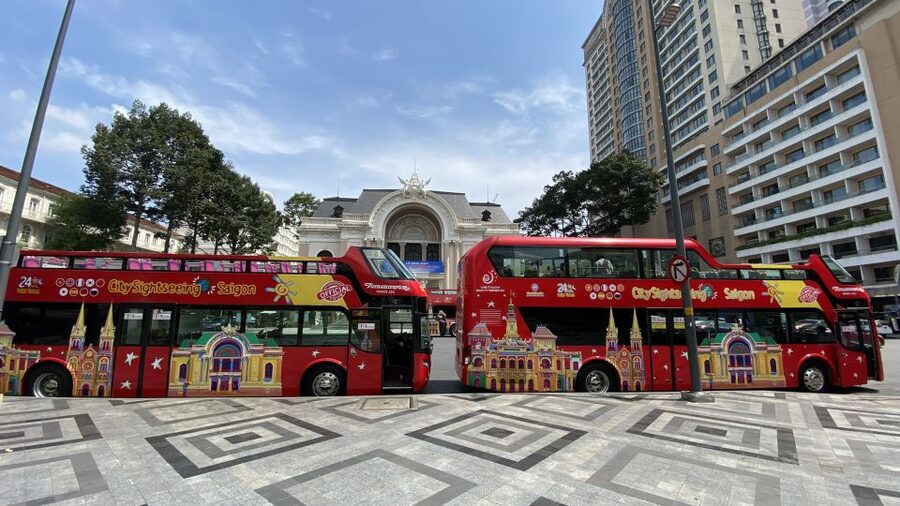
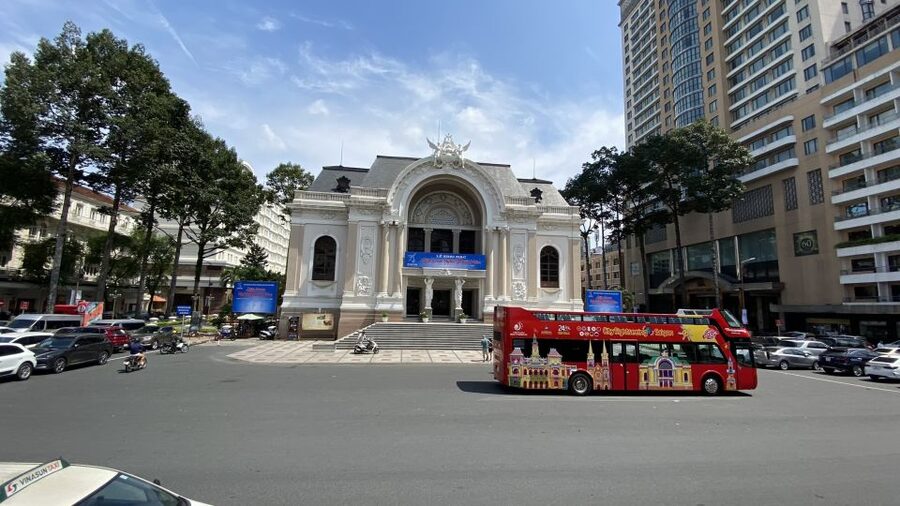
The ticket exchange counter is beside the Saigon Opera House, facing the Continental Hotel. This is the practical starting point for the red route, and it puts you directly in one of the city’s most impressive areas.
The Opera House is a fine example of French colonial architecture. From here, the route moves along Nguyen Hue Street, a broad central promenade lined with major hotels, shops, and civic buildings. This section gives you the polished face of central Saigon before the bus moves toward the river.
The first departure from Stop 1 is at 9am, with the last departure at 4pm. A full red-route loop takes about 75 minutes, and buses are scheduled every 30 minutes. Those times are useful, but remember that city traffic can affect the actual wait.
Use a mobile voucher or paper voucher. You may need to exchange it at the counter before boarding. Bring your passport or ID card, since it is listed as required for the activity.
Red Route: central Saigon in 75 minutes
The red route is the better choice for a first look at the central districts. It includes the main civic sights, museums, market area, riverfront, and several popular visitor streets.
Saigon Opera House and Nguyen Hue Street
Begin with the Opera House, then continue along Nguyen Hue Street. This is an easy place to start because several major sights are close together, and you can walk around before or after your bus ride.
The bus gives you a broad view of the central core without asking you to navigate every crowded crossing. If you sit upstairs, keep your camera ready, but also keep an eye on overhead branches and the heat.
A completely different kind of day out of Ho Chi Minh City:
- Cu Chi Tunnels Tour from HCM City – Morning or Afternoon
★ 5.0 · 15,833 reviews - From HCM City: Mekong Delta Tour with Sampan Journey
★ 4.5 · 13,132 reviews - HCM: Cu Chi Tunnels-Tapioca Small Group Tour Morning or Afternoon
★ 5.0 · 7,485 reviews - Cu Chi Tunnels and Mekong Delta Signature Tour
★ 5.0 · 7,328 reviews
Nha Rong Wharf
The route continues toward Nha Rong Wharf, a riverside stop with an important place in the city’s story. The bus is particularly useful here because the riverfront is not always part of a short walking circuit through central District 1.
This is a good point to remain on board if you are using the ride as an orientation loop. If the riverside area is a priority, check the stop position carefully before getting off.
Tran Hung Dao Statue
The Tran Hung Dao Statue marks another central point on the red route. This stop helps connect the riverfront and central areas, and it is also one of the suggested places to switch routes.
The route information advises changing from red to blue at red-route Stops 6, 7, or 8, corresponding to blue Stops 1, 2, and 3. In practical terms, that means you can link the routes around the War Remnants Museum, Pham Ngu Lao Street, and Ben Thanh Market.
Museum of Vietnamese History
This stop brings you toward the city’s museum district. The bus makes it easier to combine central sightseeing with cultural stops that sit outside the main shopping streets.
If you plan to enter museums, allow much more time than the bus loop itself. Attraction admission is not included, so the $21 ticket covers the bus, commentary, Wi-Fi, and route access, not museum entry.
War Remnants Museum
The War Remnants Museum is one of the most important stops on the red route. It offers a serious look at the Vietnam War and its effects, so plan on a focused visit rather than a quick photo stop.
The stop is also a useful transfer point for the blue route. If you want to see both routes in one day, this is one of the logical places to change buses. Just remember that the blue bus runs less often, every 45 minutes, so check the timetable before leaving the red bus.
Pham Ngu Lao Street
Pham Ngu Lao is a lively central area known for budget accommodation, restaurants, bars, and easy access to the city’s visitor infrastructure. It is also the first stop on the blue route, making it a practical interchange.
This area can be a good place to end your ride if you want food or a drink rather than another loop. The bus does not include food or drink, so this is a convenient stop for arranging your own break.
Ben Thanh Market
Ben Thanh Market is one of the best stops for a taste of Saigon’s commercial energy. You can browse souvenirs, look at local produce, and find street food nearby. It is also a useful place to switch routes, since it appears as Stop 8 on the red route and Stop 2 on the blue route.
Allow time for the market, but keep your expectations realistic. This is a busy shopping stop, not a quiet museum visit. Prices, heat, crowds, and persistent sales pitches are part of the experience.
Independence Palace
The Independence Palace is a major central sight and an obvious place to hop off. The stop can be difficult to identify, so use the guidebook and ask staff if you are unsure where to get down.
Its position makes it easy to combine with the War Remnants Museum and the Notre Dame Cathedral area. If you want to enter, check the opening details separately because admission is not part of the bus pass.
Notre Dame Cathedral and Central Post Office
The final red-route stop is at Saigon Notre Dame Cathedral and the Central Post Office. The cathedral is one of the city’s best-preserved French colonial buildings, while the post office remains one of the most photogenic public buildings in central Saigon.
This is a strong place to finish the red loop on foot. The two buildings are near other central sights, so you can walk around rather than wait immediately for another bus.
Blue Route: District 5, markets, and temples
Do not treat the blue route as a spare loop. It reaches a different side of Ho Chi Minh City and is the better choice if you want more than the standard District 1 circuit.
The blue route takes about 80 minutes. The first departure from its Stop 1 is at 9am, the last is at 3:45pm, and buses run every 45 minutes. That slower frequency makes planning more important.
Beer Street and Ben Thanh Market
The route begins at Beer Street on Pham Ngu Lao Street, then reaches Ben Thanh Market and the War Remnants Museum. These first three blue stops overlap with the central red-route area and make route changes fairly simple.
You can ride the red route first, switch near one of these points, and continue on blue. Just allow time for waiting, walking between the bus and the attraction, and traffic delays.
Ho Thi Ky Flower Market
Ho Thi Ky Flower Market gives you a different view of Saigon. It is less about grand buildings and more about commerce, color, deliveries, and neighborhood activity.
This is exactly why the blue route is worth your time. It moves beyond the central sightseeing circuit and shows you a less polished, more everyday part of the city. If you want a market visit with a different mood from Ben Thanh, this is the stop to choose.
Phuoc An society’s premises
The route then reaches Phuoc An society’s premises. The supplied route information gives the stop but does not explain the admission details or length of a visit, so check locally before making this your only planned stop.
As with several blue-route locations, the value is in seeing another part of the city and having a bus connection between districts. Do not assume every stop sits directly beside the sight named on the timetable.
Ong Bon Pagoda
Ong Bon Pagoda is one of several religious sites on the blue route. This stretch of the tour is useful if you want to see Chinese-Vietnamese cultural influences and temple architecture beyond the central colonial quarter.
Dress and behave respectfully when entering religious sites. The bus provides transport, but you are responsible for observing local rules once you get off.
Binh Tay Market
Binh Tay Market is a major reason to take the blue route. It offers a different market experience from Ben Thanh and places you in the older commercial quarter of District 5.
This is a good stop for browsing and people-watching, though you should allow enough time to return to the bus. Since buses are only about 45 minutes apart, missing one can change the shape of your afternoon.
Thien Hau Pagoda
Thien Hau Pagoda is another important temple stop in District 5. It gives the blue route a strong cultural focus and helps explain why this route feels different from the red circuit.
If you enjoy religious buildings, markets, and local neighborhoods more than a list of famous central landmarks, give blue priority. It may be the most rewarding route for a second day.
Van Phat Pagoda
Van Phat Pagoda completes the blue route. By this stage, you will have crossed into a part of the city that many short visits miss.
The full blue loop is long enough that you should not try to cram in every stop during a single afternoon. Pick one market and one temple, then stay on board for the rest of the circuit if you want a relaxed day.
Top deck views, air-conditioning, and weather
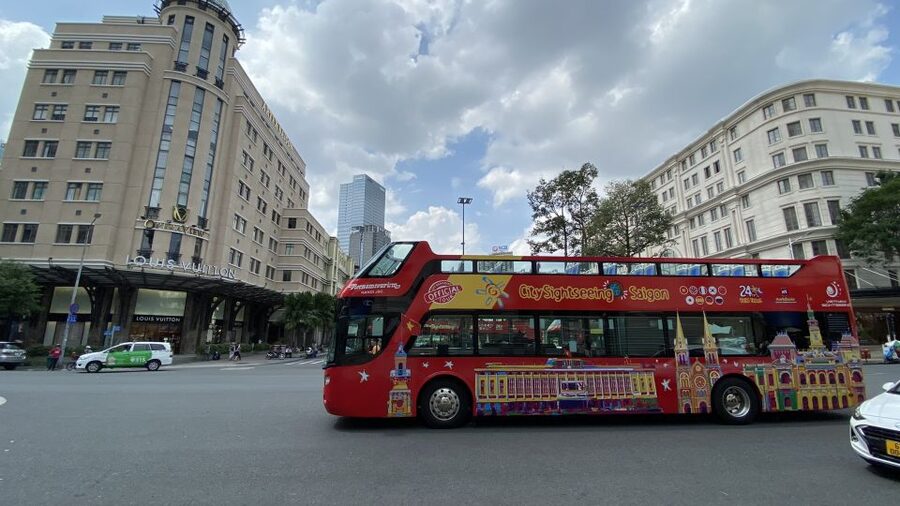
The upper deck gives you the best view and the best sense of how Saigon works. You can see over some traffic, photograph buildings more easily, and watch motorbikes weave through the streets. It is also exposed to strong sun and rain.
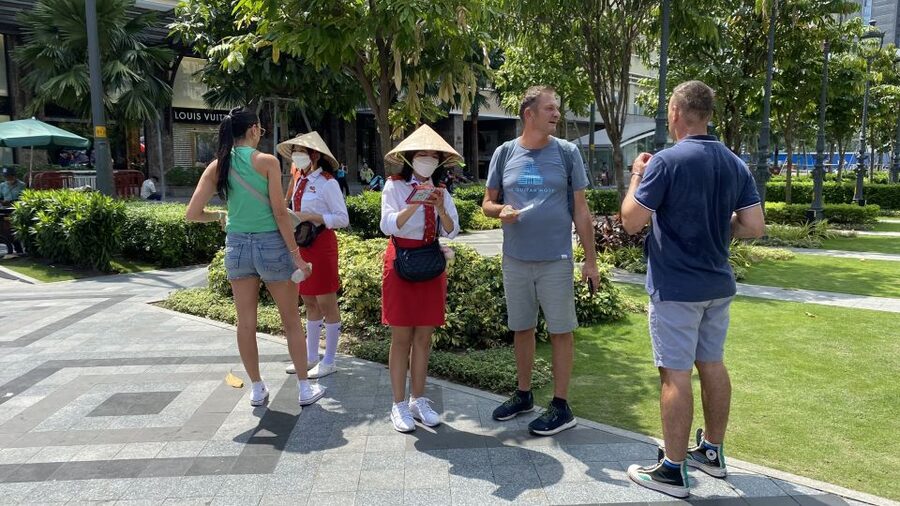
Staff have provided conical hats during hot conditions and ponchos when rain arrived. That is a thoughtful touch, but bring your own water and sun protection anyway. A lower-level air-conditioned area is available if the heat becomes too much.
Rain can arrive quickly, and the bus may continue operating while the weather changes. A poncho helps when you are getting off, but it does not turn the upper deck into a dry space.
Free Wi-Fi can save mobile data, especially if you are using maps to find your way back to a stop. The free guidebook is also useful because it includes maps, recommendations, timetables, and coupons.
Is $21 good value?
At $21 per person, the pass is fairly priced if you use it as transport and sightseeing in one. It works best when you complete a full loop, hop off at two or three attractions, and use the bus again later.
It is less attractive if you only want to travel between one or two places. A taxi or Grab ride from attraction to attraction may cost less in that situation, especially if you are traveling with others and splitting the fare.
The two-day option is the better value for a slower visit. Use one day for the red route and central sights, then save the blue route for District 5. Trying to cover both routes, enter several museums, visit markets, and stop at temples in one day will feel rushed.
The pass does not include hotel transfers, food, drinks, or attraction tickets. You are paying for the bus network, not a fully escorted sightseeing day.
Recorded audio and the role of staff

The driver speaks English, but the main sightseeing information comes through recorded audio. Headphones are provided, and the nine-language choice is useful for mixed-language groups.
The commentary can give you a solid introduction to the buildings and districts. It is especially helpful on the first loop, when you are trying to work out what deserves a return visit.
The system is not perfect. On some buses, the sound has been unreliable. At times, the volume is too low for the noise of the streets, and the blue-route commentary may refer to a building just before or after you pass it. I would treat it as background information, not a precise guided lesson.
Ground staff have been praised for helping passengers find the correct bus, offering hats and ponchos, and explaining the route. That matters because several stops lack obvious hop-on hop-off signs.
Practical ways to plan your day

Start at the Opera House and exchange your voucher before you are ready to board. If you arrive early, you can look around the Opera House and Nguyen Hue area while waiting.
For a one-day pass, ride the red route first. Get off at the War Remnants Museum, Independence Palace, Ben Thanh Market, or the Notre Dame Cathedral and Central Post Office area. Then connect to the blue route only if you still have enough daylight and patience for the longer interval between buses.
For a two-day pass, spread things out. Make the first day a central Saigon day and the second a District 5 day. That plan gives you time for museums and temples instead of viewing them through a bus window.
Keep the timetable with you. The red route ends earlier than some people expect, with the last departure from Stop 1 at 4pm. The blue route’s final departure is at 3:45pm.
Who should book this bus?

I would recommend it to you if this is your first visit, your stay is short, or you want a simple way to see several districts without arranging separate rides. It is also useful for families who need the freedom to stop and rest, and for anyone who wants an easy overview before choosing museums, markets, and temples.
It suits you less if you prefer a local guide who can answer questions, or if you plan to spend the whole day inside attractions. You may also find individual Grab rides cheaper for a small number of short journeys.
Book it if you will use the routes actively. Ride the full red loop, choose at least two stops, and make time for the blue route if District 5 interests you. If you only want a 45-minute city circuit, confirm the exact ticket type and operating time, since some evening rides appear to be separate from the standard daytime hop-on hop-off service.
FAQ
How long is each bus route?
The red route takes about 75 minutes for a full loop. The blue route takes about 80 minutes.
How often do the buses run?
Red-route buses run every 30 minutes. Blue-route buses run every 45 minutes.
What time do the daytime routes operate?
The red route’s first departure from Stop 1 is at 9am and its last departure is at 4pm. The blue route starts at 9am, with the last departure from Stop 1 at 3:45pm.
Where do I exchange my ticket?
You can exchange your mobile or paper voucher at the ticket counter beside the Saigon Opera House, facing the Continental Hotel.
Which languages are available for the audio guide?
Audio commentary is available in English, Spanish, German, French, Chinese, Japanese, Korean, Vietnamese, and Russian.
Are attraction tickets or food included?
No. The pass includes the hop-on hop-off bus, audio guide, headphones, Wi-Fi, and access to both routes. Food, drinks, hotel transfers, and entry to attractions cost extra.
Just added around Ho Chi Minh City
- Ho Chi Minh city Street Food by scooter tour | female driver★ 5.0 · 3 reviews
- Vung Tau City Shore Excursion from Phu My Port★ 5.0 · 3 reviews
- Ho Chi Minh City: Full Long Tan Battlefield Tour★ 4.7 · 3 reviews
- Ho Chi Minh City: Guided Food Tour by Scooter★ 5.0 · 3 reviews
- Ride Saigon: Private Half-Day Motorbike Adventure★ 5.0 · 3 reviews
- PHU MY SHORE EXCURSION: Saigon Past and Present Tour★ 5.0 · 3 reviews
- Ho Chi Minh: Cai Be-Mekong Delta Local Village Full Day Tour★ 3.7 · 3 reviews
- 3D2N Mekong Delta Tour: Cycling – Kayaking – Floating Market★ 5.0 · 3 reviews
City Tours, compared.

Ho Chi Minh City Street Food Tour & Sightseeing By Motorbike
Read our review →
Street Food Tasting & Sightseeing Tour by Motorbike
Read our review →
Small-group Saigon City Tour: 4-Hour Must-see Iconic Landmarks
Read our review →
Saigon Unseen, History, & Hidden Gems Sightseeing Motorbike Tour
Read our review →
Ho Chi Minh City Tour by Motorbike with Female Riders | KissTour
Read our review →
Lively Saigon River Sightseeing Cruise + Guided Walking Tour
Read our review →
Cu Chi Tunnels – Tapioca & City Tour (6 Major Attractions) 1 day
Read our review →
Full-Day Ho Chi Minh City Tour with Colonial Heritage & Chinatown
Read our review →Browse the lists this tour appears in